
CHRONICLE NEWS SERVICE
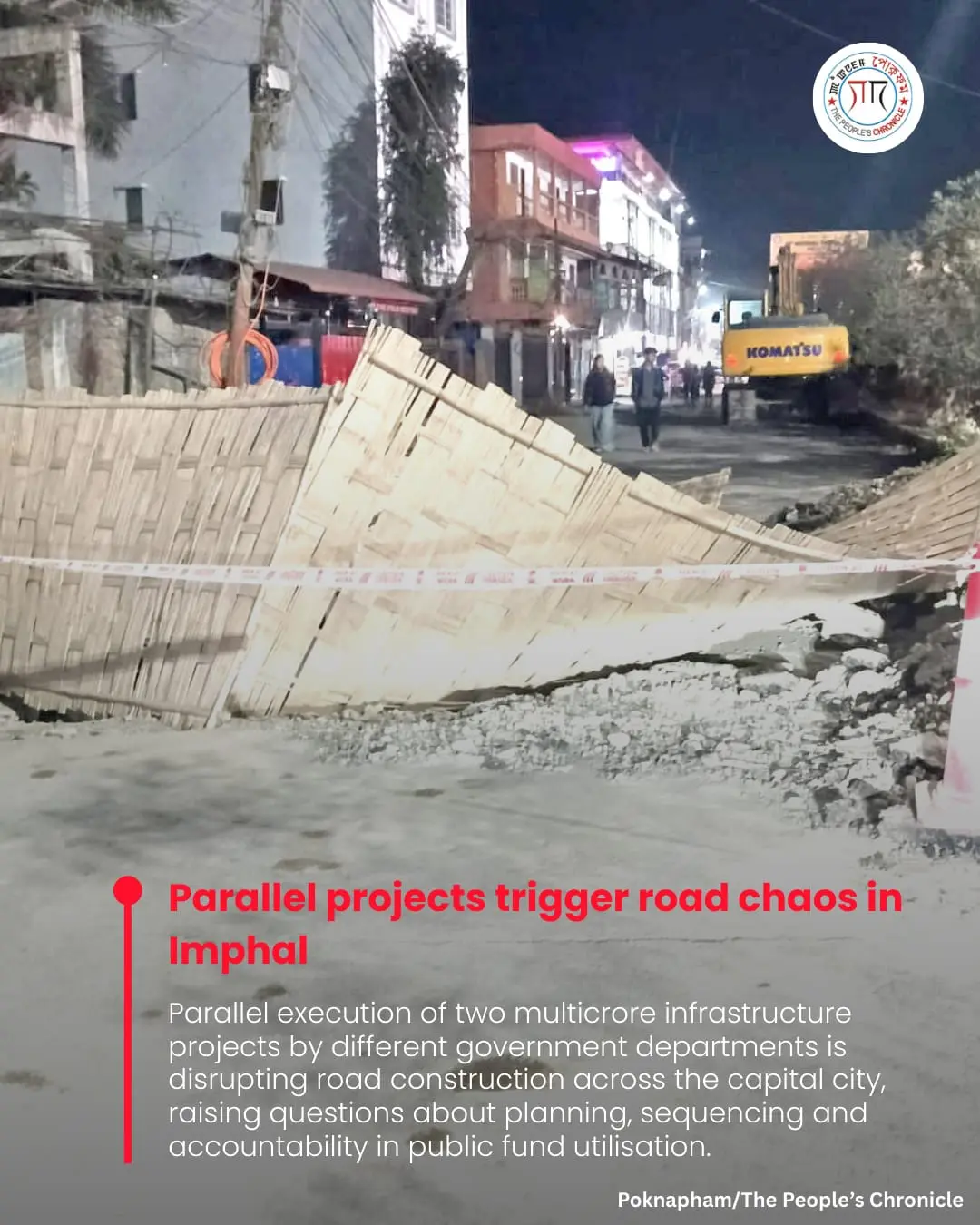
IMPHAL: Parallel execution of two multicrore infrastructure projects by different government departments is disrupting road construction across the capital city, raising questions about planning, sequencing and accountability in public fund utilisation.
An examination of on-ground conditions and official records shows that rigid pavement road works under the Public Works Department’s (PWD) Manipur Urban Road, Drainage and Asset Management Improvement Project (MURDAMIP) are being delayed or rendered ineffective by overlapping sewage construction undertaken by the Public Health Engineering Department (PHED).
MURDAMIP, funded by the Asian Infrastructure Investment Bank, carries a total outlay of Rs 3,647.23 crore, including a central share of Rs 2,896.02 crore and a state contribution of Rs 751.21 crore.
Approved in March 2025, the project aims to deliver durable roads and improve drainage across Greater Imphal within three years to address chronic flooding and deteriorating road conditions.
At the same time, PHED is implementing the “Integrated Sewerage System for the City of Imphal, Phase II,” a Rs 1,220-crore project financed through a loan from the New Development Bank approved in October 2023.
The sewage project covers most wards under the Imphal Municipal Corporation and involves underground laying of about 297 km of pipelines, constructing 24 pumping stations and establishing three treatment plants over a similar three-year period.
Field observations indicate that in several locations, deep excavations for sewer pipelines have prevented rigid pavement road works from commencing, while in other areas, road construction has been halted midway as sewer pipes are yet to be laid.
In some completed stretches, residents pointed out that concrete pavements were laid without visible prior sewage work, fuelling concerns that newly built roads may soon be dug up again.
Speaking to this daily, PWD chief engineer Chongtham Bishwachandra explained that his department coordinates with PHED, police and traffic authorities before taking up road work and proceeds with concrete paving only where there are no immediate sewage plans to avoid delays.
He conceded that work remains stalled on stretches such as Ayangpalli and JNIMS Road specifically because sewage-related activities are pending.
However, residents along the Palace Gate (Konung Mamang) to Kongba and Nongmeibung, observed that the pattern of construction suggests inadequate sequencing between departments.
Rigid pavement works had already been completed on sections such as Wangkhei Puja Lampak to Kongba and Konung Mamang to Old Checkon, even as questions persist over whether laying of sewer pipelines will necessitate digging up the roads.
Public criticism has focused on what many describe as a recurring lack of inter-departmental coordination, often summed up locally by the refrain that roads are dug up soon after being rebuilt.
People have also questioned whether long-term planning, including land acquisition and utility alignment, was completed before road works were sanctioned, warning that repeated excavation could waste public money and undermine the durability of rigid pavements.
Attempts by this daily to obtain the PHED’s response to these concerns proved futile, as the chief engineer did not respond to calls or grant requested meetings, leaving unanswered questions over how the two projects will be synchronised to prevent duplication of work and avoid further disruption.